Barco CTRL becomes first software product to achieve Barco's Ecolabel
5 分钟阅读
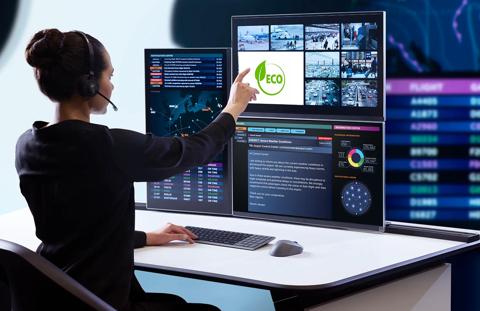
Barco CTRL, the company's all-in-one KVM over IP solution for control rooms, has made history by becoming the first software product to obtain Barco's Eco-label. This milestone marks a significant expansion of Barco's sustainability commitment, extending its rigorous environmental assessment methodology beyond hardware to encompass software products.
Barco originally developed its Ecoscoring method to address a critical gap in ecodesign. While existing methods could evaluate individual aspects of a product's environmental impact – such as energy consumption – none provided a comprehensive view that included material, packaging, transportation, and end-of-life management. To fill this void, Barco created its own holistic methodology, which was subsequently validated by third-party certification firm Vincotte.
Now, the company has adapted this approach for software, recognizing that digital products also carry environmental responsibilities that deserve scrutiny.
A lifecycle approach tailored for software
The team creating the ecoscore methodology for software, developed their framework around the complete software lifecycle, from production through usage and servicing, with a particular focus on preventing premature end-of-life scenarios. They created a comprehensive questionnaire based on extensive research and consultation with Vincotte to validate that the criteria addressed the most important environmental factors.

The methodology recognizes that software products come in different configurations, each with distinct environmental considerations:
Software running locally (on-premise)
Hybrid solutions combining cloud and local deployment
Fully cloud-based applications
Barco CTRL, which operates on-premise, was evaluated according to requirements specific to its deployment model.
What makes software sustainable?
The assessment examines multiple dimensions of software sustainability:
Energy efficiency: The team evaluates how efficiently the software is written and whether it includes features like power scaling when going into idle mode. For Barco CTRL, energy efficiency was a focus point from the start. Contrary to previous generation solutions, Barco CTRL is deployed on Eco-labeled hardware products.
Customer impact: The assessment considers whether the software contributes to the overall energy efficiency of both the customer's operations and Barco's own products. Because Barco CTRL requires modest computation power, the system needs less hardware. In addition, the hardware used is also notably sustainable (with the SAN-050 and SAS-050 achieving A++, NGS-D440 scoring A+ and the SAS-500 boasting an A Eco-score).
Longevity and security: Barco offers best-in-class security update support, recognizing that sustainability and security are intrinsically linked. The longer software remains secure and supported, the longer customers can continue using their hardware. Since security vulnerabilities are a primary reason for product obsolescence, extended support directly extends product lifespans.
Data management: The software includes encryption capabilities that enable hardware reuse, and configurable data retention windows help minimize storage footprints.
Cloud and AI considerations: For products with cloud hosting components, Barco demands best-in-class providers aligned with European taxonomy criteria. The methodology also evaluates whether AI implementations, when present, are appropriately scoped to avoid unnecessary computational overhead. This was not the case for Barco CTRL.
The assessment also connects to Barco's service score initiative, evaluating how customer-friendly the software is to service and maintain.
Binary certification with room to grow
Unlike the Ecoscore system for hardware, which includes multiple grades (A++, A+, A, B, and C) with only the top three considered Eco-labeled, the Ecoscore for software uses a binary classification: either Eco-labeled or non-Eco-labeled, without any intermediate grading. While today's standards are demanding, the approach is designed to evolve gradually, mirroring the company's experience with hardware Ecoscore development.
The team is also exploring AI-specific criteria and working to determine the optimal timing for conducting assessments during the product development lifecycle.

Hardware components of Barco CTRL
SAN-050
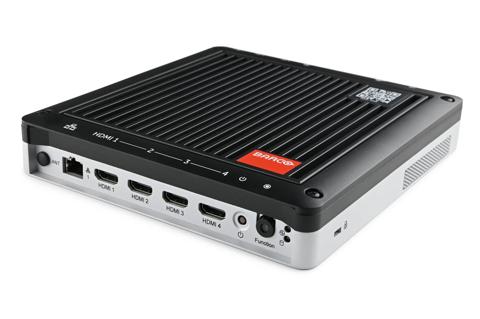
Ecoscore: A++
SAS-050

Ecoscore: A++
NGS-D440
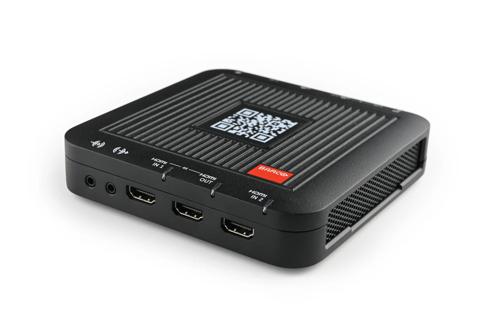
Ecoscore: A+
SAS-500

Ecoscore: A
Looking ahead
While Barco CTRL stands alone as the first Eco-labeled software product, other projects are in the pipeline. The company distinguishes between standalone software, which faces more stringent assessment, and software that runs on dedicated Barco hardware, which is evaluated primarily for energy efficiency as part of the hardware assessment.
Not every software product assessed has passed the assessment. The team confirms that some evaluations have been unsuccessful, underscoring the rigor of the standards.
With this groundbreaking update for the Ecoscore, Barco demonstrates that environmental responsibility in technology extends beyond physical materials and manufacturing. As software continues to drive modern business operations, methodologies like these will become increasingly crucial for understanding and minimizing the digital world's environmental footprint.