Migrating OpSpace to Barco CTRL 1.11: Evolution without disruption
4 分钟阅读

For organizations that invested in Barco OpSpace since its 2016 launch, there's exciting news on the horizon. The release of Barco CTRL 1.11 marks a pivotal moment in control room technology evolution, one that honors investments while unlocking future possibilities. This latest version introduces full OpSpace device compatibility, enabling a smooth migration path that protects your hardware investment while delivering the advanced capabilities of modern control room management.
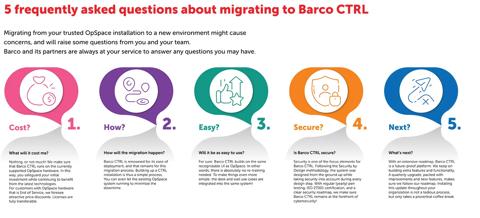
At the heart of CTRL 1.11 lies a powerful promise: your existing OpSpace hardware doesn't become obsolete. OpSpace decoders (OPS-110, OPS-210, OPS-220) and encoders (NGS-D320) can now seamlessly migrate into a Barco CTRL ecosystem. This means that the migration budget is virtually nothing. Because Barco CTRL runs on currently supported OpSpace hardware, organizations can transition to the new platform without replacing their existing equipment. Your decoders and encoders continue their service life while gaining access to next-generation capabilities.
For organizations with OpSpace hardware that has reached End of Service status, Barco offers attractive commercial incentives to facilitate the upgrade path. Additionally, licenses are fully transferable, providing flexibility as your infrastructure evolves. This cost structure reflects a genuine commitment to investment protection: you're not being asked to write off functional hardware simply because software has advanced.
Operational continuity

What makes this migration particularly elegant is its respect for operational continuity. All source types from OpSpace remain fully supported in the new environment, and crucially, the operator experience stays unchanged. Your teams won't face a steep learning curve or disrupted workflows. During the transition period, AV sources encoded by NGS-D320 can even operate simultaneously in both your existing OpSpace setup and the new CTRL environment, ensuring zero downtime as you make the switch. The technical implementation is straightforward, in line with the renowned simplicity of Barco CTRL.
What about the cost?
Perhaps the most compelling aspect of this migration is the answer to the inevitable budget question: virtually nothing. Thanks to the features included in release 1.11, Barco CTRL runs on currently supported OpSpace hardware. This means that organizations can transition to the new platform without replacing their existing equipment. Your decoders and encoders continue their service life while gaining access to next-generation capabilities.
Licenses are fully transferable, providing flexibility as your infrastructure evolves. This cost structure reflects a genuine commitment to investment protection: you're not being asked to write off functional hardware simply because software has advanced.
Why make the move?
While OpSpace revolutionized operator workspaces when it launched, Barco CTRL represents the next generation of control room platforms. The benefits are substantial and address the evolving challenges that control room operators face today.
Enhanced cybersecurity: In an era where cyber threats are increasingly sophisticated, Barco CTRL's security-by-design architecture offers peace of mind. Built on Zero Trust principles with encrypted communications as standard, the platform meets the stringent security requirements of mission-critical operations. This represents a significant step forward from legacy systems and positions your control room to meet current and future compliance standards.
Unified platform philosophy: Perhaps the most compelling advantage is Barco CTRL's all-in-one approach. Where OpSpace focused exclusively on KVM functionality and operator desk management, CTRL manages both desk and video wall environments within a single, cohesive platform. This unified architecture eliminates the complexity of running multiple systems, streamlines administration, and creates a more intuitive operational environment. For IT teams, this consolidation translates to simplified maintenance, reduced training requirements, and more efficient troubleshooting.
Future-ready scalability: As your control room requirements evolve, CTRL grows with you. The platform's modular architecture allows you to expand capacity simply by adding encoders for more inputs or decoders for additional operator positions and video walls. This flexibility ensures your investment remains relevant as operational demands change. The integration with Extreme Networks for secure connected control rooms is an example of how scalability can expand beyond the boundaries of a single control room.
Notable features in CTRL 1.11
Beyond the headline OpSpace migration capability, version 1.11 introduces several practical enhancements that improve daily operations.
Personal RDP sources bring a consumer-grade convenience to enterprise environments. Operators connecting to their personal RDP sources now experience SSO (Single Sign-On)-like behavior: enter your password once with the option to save it, and subsequent connections happen seamlessly. This small change eliminates repetitive authentication steps that, over the course of a day, can add up to significant time savings.
RDP audio support: CTRL 1.11 enables operators to listen to and control audio from RDP sources directly at their desks. Whether it's monitoring audio feeds or accessing audio-dependent applications, this capability enhances the operator experience and expands the types of tasks that can be efficiently managed from the control room.
Additional refinements include custom resolution support for NGS-D440 encoder devices, expanded camera source protocol support (including RTP/UDP multicast), and various usability improvements like automatic focus on the username field during login – which are the kind of thoughtful details that make daily operations smoother.
Making the transition
The investment protection that CTRL 1.11 offers shouldn't be underestimated. In an industry where technology refresh cycles can force premature hardware replacement, the ability to migrate existing OpSpace equipment represents significant cost savings. These measures underline Barco's commitment to both customer investments and the environment. The fact that Barco CTRL is the first software platform to achieve the Barco Eco-label for software is evidence of this commitment.
For decision-makers evaluating control room infrastructure, this release makes a compelling case. You gain access to cutting-edge capabilities in cybersecurity and unified platform management while honoring the investment decisions made years ago. It's technology evolution done right: respectful of the past, optimized for the present, and ready for the future.
Ready to explore how Barco CTRL 1.11 can transform your control room operations? Contact your Barco representative for detailed technical information about the OpSpace migration process and to discuss how CTRL 1.11's enhanced capabilities can address your specific operational requirements. For comprehensive migration guidance, refer to the OpSpace Migration Guide (R5919691).